Clothing
Spier & Mackay Jeans Review: Why the $5 Hem Might Matter More Than the Denim
Finding pants that fit right off the rack is mostly luck. Waist, seat, thigh, and inseam all have to land correctly at once, and for a lot of bodies, at least one of those is always a little off. The usual fix is a tailor, and a tailor means an extra errand, an extra few days, and an extra charge every single time. We’re busy enough that avoiding that trip, when it’s avoidable, is worth actively designing around, not just tolerating.
What’s actually being sold here.
Spier & Mackay isn’t a fashion brand cosplaying as a value brand. It started in 2004 when founder Rikky Khanna, whose family had been in textiles and apparel for fifty years, found he could buy dress-shirt-grade cloth directly from the same mills luxury brands use, at wholesale prices, on a trip through a South Asian textile market. The company spent years refining that direct-sourcing model before actually launching in May 2010, both online and out of a single retail location in Mississauga, Ontario. The pitch was always the same: cut out the markup layers between the mill and the customer, and pass the difference along as fit and quality instead of margin. Suits and shirts came first. Denim came later, built on the same logic: fewer middlemen, the savings visible in the price tag instead of eaten by a brand premium.
The denim, the cords, and the actual numbers.
We own a few pairs of the five-pocket denim, including the ochre and sage washes, and one pair of the same five-pocket cut in a dark brown corduroy. Same cut across all of them, just different fabric and color. The jeans currently run $98, up from $68 when an early reviewer covered them back in 2021, worth knowing if you’re comparing to an old price you saw quoted somewhere.
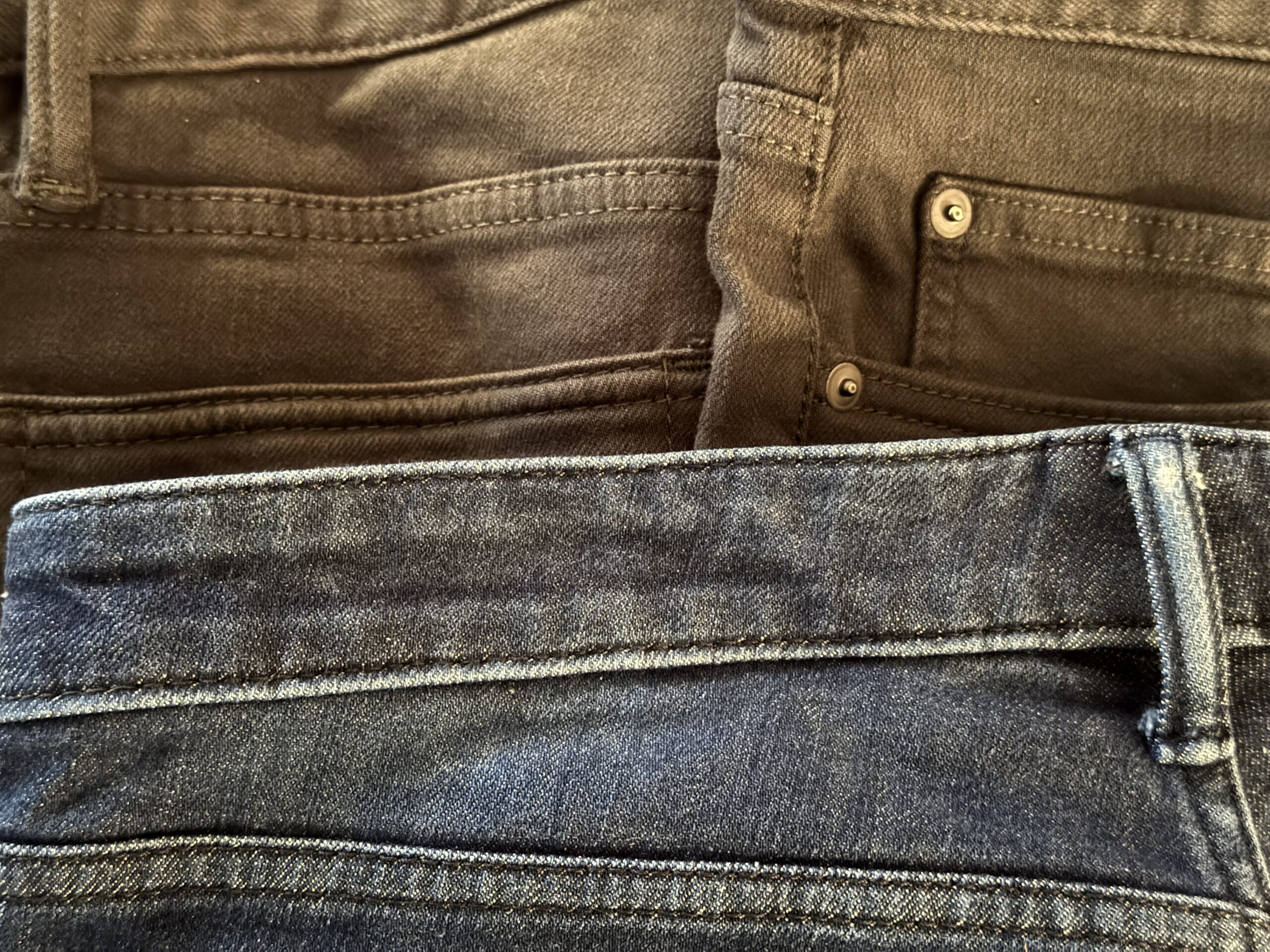
They’re 100% cotton with no stretch, a standard 12oz weight (their separate High Rise Denim line goes up to 13oz), and the details that actually show up in daily wear are real: a contoured waistband that doesn’t gap at the back, copper rivets, a nickel button, a leather patch instead of a printed one. One sizing quirk worth knowing before you order: the washed versions run true to their own size chart, but the dark, unwashed rinse wash fits about a size big, so size down if that’s the one you want. The corduroy holds to the same cut and the same no-stretch honesty, though our exact pair has since gone final sale, one more reminder that Spier & Mackay cycles specific washes and colors in and out of stock regularly. It’s not trying to be athletic-fit anything, and we like it more for that.
The hem system, and why it matters more than it sounds like it should.
Here’s the part that actually changes how these fit. Spier & Mackay’s jeans ship unhemmed by default, and you specify the finished length in half-inch increments at checkout, not a size chart’s idea of “short, regular, tall,” the actual number you need. Two finishing options exist once you pick that length: a plain chain-stitched hem, or what’s sometimes called an original or Euro hem, where they cut the original hem off close to the seam, shorten the leg, and resew that same original hem back onto the shortened leg. Done right, that second method is nearly invisible, since the factory finish on the outside of the leg never actually changes, it’s just relocated. Chain-stitching itself is a real thing to offer casually: most local tailors don’t have the machine for it, and finding someone who does usually means mailing jeans across the country and waiting. We paid $5 for the plain chain-stitched hem and $12 for the original hem, built right into the order, no separate shop visit, no separate appointment.
The math on skipping a tailor.
For scale: Denim Therapy, a well-known mail-in denim specialist, publishes $35 for a chain-stitched hem and $40 for an original hem, and that’s before shipping the jeans there and back and waiting on turnaround. A regular local tailor typically runs $15 to $35 for a basic hem on jeans, and $45 to $80 if you want that same original-hem preservation done locally. Spier & Mackay’s $5 and $12 aren’t a discount on that, they’re a different order of magnitude, folded into buying the pants in the first place instead of a second errand and a second bill.
The neighbor on the sidewalk.
The clearest proof of what a correctly hemmed pair of pants actually does came from someone who wasn’t trying to make a point. Not long after buying and hemming a pair of the jeans, one of us was walking the dog and talking to a neighbor, who stopped mid-sentence to ask if they were custom, pointing specifically at the break at the ankle. They weren’t. They were a $98 pair of off-the-rack jeans with a $12 hem. But a break that lands exactly where it should, instead of stacking in a pile of extra fabric or riding an inch too high, is apparently rare enough that a neighbor on a dog walk notices it by name.
Where they land against other jeans at this price.
Everlane’s slim-fit jeans run $88 and come in fixed inseam lengths, 28, 30, 32, and 34 inches, so you’re still picking the closest available number rather than your actual number. Uniqlo goes further with free universal alterations on most of its pants, but the shortest inseam it offers standard is 26 inches, which doesn’t solve the problem for anyone who needs something between the fixed points on either brand’s chart. Spier & Mackay’s half-inch-increment ordering solves that specific gap directly, at checkout, for a few dollars. As for the jeans themselves against similarly priced denim generally, they hold up reasonably well for what they are, and for us they feel on par with, maybe a shade better than, other jeans in the same price bracket. Not the most exciting claim in this piece, but an honest one: nobody needs the reference denim of their price tier so much as they need pants that actually fit when they put them on.
Enough, not more.
We’re not working through every wash or every fit Spier & Mackay makes. A couple of pairs of the five-pocket denim and one pair of the corduroy cover what we actually reach for, and reordering the same fit once it’s dialed in is easier than starting over with a new brand every time a pair wears out. The real win isn’t the denim being remarkable, it’s that the friction of getting pants to actually fit dropped low enough that we stopped avoiding it.
The full lineup

Five-Pocket Denim, Ochre Wash
Check Price at Spier & Mackay →
Five-Pocket Denim, Sage Wash
Check Price at Spier & Mackay →